Showing posts with label fabric. Show all posts

Sunday, September 9, 2012

Safflower and Spoonflower.2

A close-up of yesterday's image.

You can see more of the fabric design here. I've not printed on Spoonflower for quite a while. After posting this image, I placed an order for a sample of their current fabrics so I can select a fabric for printing this as yardage. I don't remember what I chose for this swatch but it has a lovely luster -- not in-your-face shiny -- just a luminous luster

Actually, I created many variations on this theme and now I'm not sure which of my designs this is (some are visible on Spoonflower and some are hidden), so I may have to print several of the designs so I can tell them apart. This could become expensive, but printing a yard or two of the wrong fabric would also be expensive!

Saturday, September 8, 2012

Safflower and Spoonflower.1

Treated myself to flowers today and made four arrangements. I'll try to post a new pix each day.

The orange blossoms are safflower. I think of safflower as an oil. Who knew? It's a plant with fluffy orange blossoms! Apparently, they are sometimes used as a cheap substitute for saffron. Look closely at the unopened buds (click on the image to enlarge it) -- the buds are covered with little leaves.

The large leaves at the neck of the vase are hydrangea leaves. I think they showed up better in the picture below.

That's one of my Spoonflower swatches in the background. This has me thinking, I should print this up as yardage and do something with it. It's been years and I still like it and still yearn to see it as a big expanse of fabric.


Tuesday, August 24, 2010

Ikat

This is a piece of ikat, that I bought decades ago. I kept the selvage edges and fringed the two cut edges to follow the diamond design. I wish I had continuted the zig-zag line into the red border.


Creating ikat is not for the faint of heart. The yarn is dyed before the cloth is woven. This one is a single ikat -- only the weft yarns are dyed in a pattern; the warp yarns either solid red or solid green. The striped arrangement of the warp creates red and green checks as it weaves through the ikat weft. This link will take you to more photos of ikat fabrics. Some of them are really quite fantastic.


The next two photos are of double ikats -- the pattern was dyed into both the warp and the weft. This dotted fabric was also shown in my previous post. The dots on this Kaffe Fassett ikat are orchid. It will also be used as a small tablecloth, and I'm trying to decide how to finish the edges. Fringe would be nice as it would reveal the dye work in the warp.

While just now searching for a link for this posting, I realized that I own another Kaffe Fassett double ikat, which I used for one of my Dear Jane blocks, K5 - Passing Through, allbeit as a solid.


Monday, August 23, 2010

Zinnia and Friends

This is a bouquet I put together at the farmers' market on Saturday, selecting from a collection of loose flowers.  The cloth is a Kaffe Fassett ikat. It's a big mint green square with pale orchid dots created with the ikat method. I hope to one day either fringe the two cut edges or hem them; the selvage edges are fine as is.

Saturday, July 31, 2010

The Goddesses and Me

The Goddess of Textile Shopping
So I sent up a prayer to the Goddess of Textile Shopping and she delivered big time -- that is, if the Goddess of Laundry comes through for me, too.
For several months now, I've been looking for large prints with flowers and birds; bugs and frogs would have been nice, too. After shopping in nearly every local fabric store and a few online, I concluded that I should be looking at interior decor fabrics.

The Jackpot
I hit the jackpot today when I went to the Exeter Handkerchief Company, which is now managed by the third generation of the same family. When I first discovered this store 30 years ago, it sold garment fabrics and interior decor fabrics. Now a days, it focuses exclusively on home decor fabrics. The first two floors of their sprawling building offer dozens of upholstery and drapery fabrics. They have gone beyond just showing fabrics on bolts, and also show them on vertical displays to suggest fabric combinations and possible trims.

I found lots of yummy textiles. Every thing on the first two floors is marked down but it's still beyond the usual prices found on quilting fabrics. Some of the fabrics were in colors that would not work at all, and other were the wrong scale. Once I saw all the large prints together, I realized my project could not use gynormous prints.


The Third Floor
I headed to the "remnants" on the third floor, and found hundreds of fabrics on tubes -- some suspended and many more just stacked on shelves. On this floor, nothing in particular spoke to me, which is too bad since everything is $8/yard -- except on Tuesdays, when it's $5/yard.

In the End
A fabric by Braemore Textiles (on the fist floor) kept calling my name, so I bought one repeat -- 3/4 yard. That's all I need for a few fussy cuts.

The Goddess of Laundry
Now I'm saying a new prayer. All the fabrics are supposed to be dry cleaned. Since they cut the fabric generously, I will cut out a chunk, zigzag the edges, and toss it in with my regular laundry after saying a prayer to the Goddess of Laundry. I'm hopig for the best, because I am in love with these colors and these sweet birds. Doesn't that first bird looks like he's wearing a tie? I think it's the band of color around his neck. Click on the photos for a closer look.

The text in the selvage says they used reactive dyes.According to this link, reactive dyes are pretty colorfast, so I'm hoping for the best. I'm hoping it's a cotton. What do you think?

Tuesday, July 20, 2010

New Fabric, New Quilt Exhibit

New Fabric
Was it last week that I told a friend, "I'm not buying fabric online ever again. I keep getting unpleasantly surprised by the colors, the scale of the designs, or both." Shortly there after, I caved-in to an online fabric sale. This time, I knew I liked at least one of the fabrics (second from the right) because I already had some. I'm sure glad I took the plunge! I am lovin' all this yummy stuff that just arrived today!

Broderie Perse Exhibit at the New England Quilt Museum
Speaking of pretty fabric, if you have a way to get to the New England Quilt Museum, don't miss the newest exhibit. I was there today and it's pretty fantastic. Contemporary Broderie Perse: An Elegant Revival runs from July 15 - October 17. After that, the exhibit travels to the National Quilt Museum in Paducah, KY. 

What I found engaging was the beautiful floral fabrics; the teeny-tiny buttonhole stitches that looks like they were done by machine (but they're all hand done); and the wonderful medallion quilt designs. I kept forgetting these were contemporary quilts, the colors and fabrics were deceptive.

Broderie perse literally means "Persia embroidery." You can read more about the NEQM exhibit here but note that after the exhibit closes, the information will be replaced by content relative to the next exhibit....so, I pasted part of the content into these bullets:


  • Combining collage, fine appliqué, and fine quilting, broderie perse, also known as cut-out chintz appliqué, presents a high point in the art of quilting and deserves the admiration and attention of all who appreciate fine needlework.

  • The technique emerged in the late eighteenth century when chintz fabrics were very expensive and only the very wealthy could afford whole cloth bed coverings made from large pieces of chintz.

  • By cutting motifs out of a small amount of fabric, the quilter could rearrange them onto a large field of inexpensive plain cotton to imitate the designs on larger fabrics.

  • Plain cream or white fields filled by fine quilting surround the trees, floral sprays, wreaths, urns, birds, and baskets appliquéd with tiny whip, buttonhole, or reverse buttonhole stitches.

  • The style, which was very popular in the Middle Atlantic States and the South into the 1840s, largely disappeared after the 1850s.

  • The exhibition, curated by Anita B. Loscalzo, presents 30 contemporary broderie perse quilts and several antique examples in order to familiarize viewers with the style and its history.

Sunday, September 6, 2009

Today's Treat

.
.
.
.
.

.
.
.
.
.
.
.
.
.
.
.
.
.

.
As I mentioned before, I'm newly addicted to English paper piecing. In particular, the colors in this quilt and the shapes in the block in the upper righthand corner, remind me of some store-bought coverlets my mom put on our beds each summer. I hope to soon locate some old photos with those coverlets. Perhaps I'll get more ideas!

Anyway, today, I treated myself to a large batch of new fabrics to try out EPP with fussy cuts. Some of these fabrics may end up in my Dear Jane quilt, too. I've also decided, I can no longer continue to say "I am not a blue person."

Sunday, August 23, 2009

Stash

I've had a hard time getting to this project of organizing my fabrics into this dresser drawer. The fabrics are prewashed; it's the ironing and folding that's the problem. One day (many weeks ago), without thinking about it, I found myself at the ironing board getting all the fabrics pressed and folded. There's more to go but this is an encouraging start. In case you can't tell, the fabrics are folded and standing on end.

Sunday, July 5, 2009

Passing Through

112 blocks; 66% done (not counting blocks I want to re-do)

Two Dear Jane blocks in two days! Woohoo! This one, K5 - Passing Through, came together pretty quickly; it only has 14 pieces. Now that it's done, I'm not sure what is "passing through." On Jane's block, it's clearly the diamonds, but with this fabric choice, it could be the diamonds, or it could be the flowers.

Drafting and Fabrics
I redrafted this block to more closely match Jane's construction by changing how the diamonds are set into the ivory fabric. The fabric for the diamonds is a Kaffe Fassett ikat. Ikat is an amazing fabric. The pattern is printed onto the yarns before they are woven!

I don't know who designed the fabric with the flowers. If you do, please drop me a comment. It is so beautiful. It's really designed for a much larger application. After cutting out the flowers, I'm left with a large field of lime green fabric -- with delicate ivory tracings running through it (click on photo if you cannot see the ivory lines). Oh well. It's still yummy stuff.

Next?I'm in the midst of working on the largest ring of this Trip Round the World color arrangement. That means I'm working in green, green, and green. I may take a break and work on another color by making one of the blocks that I plan to replace. When I started the blocks, I had no intention of making a Dear Jane quilt, so I did not bother with planning out colors and careful fabric selections. On the other hand, I have some rather challenging blocks ahead of me in this green ring; they have lots of tiny pieces. It might be nice to get them out of the way.

Friday, June 26, 2009

Where Have All the Flowers Gone?

110 blocks
After completing my latest Dear Jane block, D10 - Battlefield, I realized that it has 42 pieces. No wonder it took me so long!

The FabricsI knew I needed a relatively solid fabric for this block or else all the piecing would "fall away." This lesson came to me while working on my previous block. It's annoying to put a lot of effort into a block and not have your work show because you chose the wrong fabric.
I considered this fabric because it reminds me of combat fatigues but I was afraid it might do it's "fatigue thing" and make carefully pieced green trianges blend in with the ivory ones. After all the work, I like my blocks to be easy to "read." Perhaps I was too cautious, but I kept looking. When I found this fabric a song popped into my head and I new I had found more than what I was looking for!

The Song
"Where Have All the Flowers Gone?" was written by Pete Seeger and Joe Hickerson. I encourage you to visit Wikipedia to learn about Seeger's original inspiration, a Ukrainian folk song. The most surprising fact is that the first person to perform the song is Marlene Deitrich. In case you've not heard it, or you want to hear it again, here's a recent recording by Joan Baez. Search around on YouTube and you will find recordings by everyone from Pete Seeger to Dolly Parton! While they do not credit both writers, the lyrics are here.


The Photo
I took this photo on an overcast day. The details of the fussy cutting do not show. The sun came out today but I got lazy and did not do a re-shoot. Lately, I've been cropping my photos of my Dear Jane blocks so they can be seen as they will look after they are set into the quilt. This block was not cooperating -- so it's cropped a bit larger. The block is a little bit wonky at the corners, and I could not seem to frame the block square.

Friday, May 30, 2008

Big Band Fabric -- and the Sheik of Araby

This is the fabric I started talking about yesterday. If you happen to know where I can get more, please give me a shout. It would be a miracle to find more of this fabric today since this was likely purchased in 1998 or 2003. I never expected to like it so much. The quilt recipients clearly love this fabric, too. It goes well with their love of music and their NYC brown stone decorated in a a playful mix of the old and the new. [To date, they have a matching pillow, have seen the quilt top in person, and the label on yesterday's post.]

If I'd had more of this fabric, I might have used it for the backing. It's possible the fabric would have lost its punch when used in a large expanse. Perhaps that's why I did not fully recognize its potential as it came off the bolt. I really don't remember what I was thinking when I bought it (possibly eight years ago) other than I needed lots of different black and white fabrics.

I used most of what what was left for the quilt label. At this point, I don't even have a full lengthwise repeat. If I found more of the big band fabric today, I might make a few items to go with the quilt. (Here are a few shots of the pillow I made to go with the quilt.)This is the type of experience that ultimately leads a quilter into overstashing and then (hopefully) into a 12-step program such as Fabric Stashers Anonymous!

A final note. When I look at this fabric I hear The Sheik of Araby. Have a listen!


Oscar Peterson
New York Ukelele Ensemble

Rocky Mountain Rhythm Kings

Reggie Houston

Orchestre Ducoin

Django Reinhardt

?An Austrian group?

Tuesday, May 13, 2008

Drafting Melissa's Cross

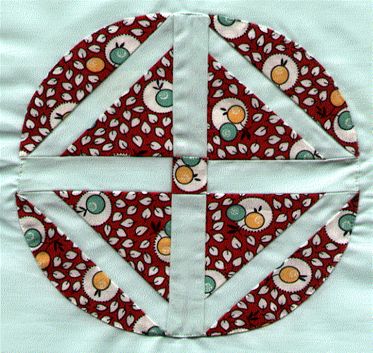
This Dear Jane block, B11 - Melissa's Cross, took a lot of effort before I ever got around to cutting the fabric and handpiecing the block. As I explained in my post on May 6, Jane's block and Brenda's draft do not match. The photos at the two links below say it all.
This one matches Brenda's draft (Sorry, the link is broken. But if you try this link, you will see the variety between different versions of this block.) The points on the diamond are cut off; the diamond outline and it's crosshairs are two different widths -- on Jane's block, they are the same width.
This one more closely resembles Jane's block -- with a few differences: on Jane's block I never could decide if the 4 curved pieces were forming a circle or a square with rounded corners but, this example makes them into a circle; the diamond outline and crosshairs are still two different widths. Notice that in Jane's version the points of the diamond unit extend beyond the edge of the curved area.

Drafting
These minute differences add up to two blocks that are similar but not identical. I decided I wanted my block to more closely resemble Jane's, so I pulled out my graph paper, pencil, and ruler, and made several drafts. I tried different widths for the crosshairs -- first 1/2 inch and finally 3/8 inch. [NOTE: These are the measurements after the block is pieced. They are all cut bigger to create seam allowances. Read below for more details about seam allowances.] In the upper block, I drew a different curved piece (freehand) in each quarter so I could pick one. I chose the curve I liked the best, cut it out, and then recut it out from a piece of paper folded in half -- to assure symmetry. In the end, I decided to make the crosshairs 3/8 inch wide and the curved pieces are not exactly a circle.


Cutting and Marking
Two different fabrics were used for the fussy cuts. For seams that I know I will trim later, I'm not very precise -- I just cut it larger than I need it. As I cut the fabric, I leave at least 1/4 inch for interior seams -- and 1/2 inch on the outside edge of pieces that will join to the sashing to give myself some wiggle room in case things get wonky. That's my "Dear Jane Insurance Policy." When I cut the pattern and fabric, I marked the centers of the curved seams so I would know how to position them. If I could change one thing, I would have marked the pattern pieces to show where the first corner unit is joined to the diamond-shaped unit -- for step 5 below.

Seaming Sequence
  1. Sew the long sides of one of the crosshair bars between two triangles. This forms a triangular unit. Repeat for the other side. You will have 2 triangular units with one of the crosshair bars running up the center. I trimmed the seams quite narrow because I wanted to press the seam allowance toward the crosshair, and the crosshair bars are only 3/8 inch wide.
  2. Sew the 3/8 inch square between the short ends of two of the crosshair bars. That unit is long and narrow. Trim seams.
  3. Assemble and sew the 3 units to form the center diamond unit. Trim seams.
  4. For each corner, sew the two curved pieces to form a piece that looks like a triangle with one corner cut off. I clipped the inside curve and pinned the seam as Anina describes in this tutorial. Sewing curves has been so easy ever since I applied her method to my handpieced curves; that means I do a lot less applique these days.
  5. Attach the 4 corner units to the center diamond. Think about where you are attaching the first corner. The rest will be easy.
The effort to draft this block was well worth the result. Remember, you can enlarge the photos by clicking on them.

Friday, May 9, 2008

Jud's Trophy

Last night, I finished hand piecing this Dear Jane block, B10 - Jud's Trophy. The small triangular pieces are 1/2 inch on the long side. I'm a wee bit mystified and disappointed that after nailing the center with all its tiny pieces, that some wonkiness showed up on the outer section. This is yet another block that looks worse in the photo than I think it looks in person. How can this be? Does my brain just tune out what it doesn't want to see? Perhaps I should open that one seam (on the bottom of the block) and straighten things out.
Done: 102 blocks/1,828 piece
Definite Keepers: 71 blocks/1,316 pieces

This is the fabric I used for the center star. It got me thinking, it would be fun to make (or maybe just own) a Baby Jane quilt that uses lots of fabrics with stars to echo the stars in the blocks near the center of the quilt. Luckily, just because I think it up does not require me to make it!

Wednesday, April 9, 2008

Colors for Baby Jane

As I mentioned yesterday, when I made my first Dear Jane blocks back in the late 1990's, I had no intention to make the whole Dear Jane Quilt. Over time, that changed.

Some time after that, I recognized Jane Stickle's "trip 'round the world" (TRTW) color arrangement (concentric diamonds of color). I'm not the only one who did not notice this immediately. (Check out the photo in yesterday's post to study the TRTW pattern.) I think it's because of the variety among the blocks -- variety in the fabrics (a different one for each block), and the difference between the blocks themselves. The first overall impression is the sheer variety among the blocks. Anyway, I liked Jane's TRTW plan but, by then I had made some choices that ran against such an arrangement (if I was going to keep each block in the the same position as Jane's blocks.)


Inspiration
Meanwhile, I fell in love with this fabric. It reminded me of mother-daughter dresses that my mom sewed when I was about 3 years old. I loved those dresses. It was so fun to have a dress that matched my mother's! That 1950's dress fabric had a white background but something about the shapes and colors of the flowers in this inspiration fabric reminded me of those mother-daughter dresses. The colors that really caught my heart were the red, pink, sage green, and lemon yellow. Another draw was the red and pink combination -- a mix that reminds me of things Japanese. Somehow, the periwinkle never really registered in my head; that's a bit odd since periwinkle is one of my favorite colors.

I think I made two mistakes with the color: (1) I used all the colors in the fabric for my Dear Jane blocks and (2) I forgot that I was adding another color that was not in the inspiration fabric -- ivory.

How Many Fabrics?
Jane Stickle used a different fabric for every block in her quilt. (Where did they all come from?) I started out planning to do the same. That lead to using fabrics that strayed away from the inspiration fabric. I now have over 90 blocks and I have already repeated several of the fabrics. At this point, I've decided that I will repeat fabrics in the remaining blocks for this quilt. Color is that important to me. This is necessary because when it comes to fabric, all colors are not created equal. Some colors are easier to find in a store while others can require weeks or months or years of hunting. This was a hunch that was confirmed when I took a color theory workshop with Jane Balshaw this winter. Balshaw and I agree on something else -- the colors in the fabrics are coming from the three color "families." Some have a yellow base and others have a blue or red base and that is what's making it all feel "not quite right."

To be continued . . .

LinkWithin

Related Posts with Thumbnails